February: The essence of LIFE
Greetings,
There’s a kind of uniqueness with
Indian festivals, their imbuement with nature. Their systematic occurrence in
concord to climatic changes enlightens us to another facet of their arrival,
not only these festivals have historical & religious relevance, but also,
they denote the essence of nature. And nature forms the essence of life, it
being everything that surrounds us. There are so many ways and forms through
which nature represents itself and bestows its blessings upon us; one amongst
them is colors. Though it may seem usual but given a thought, there’s
everything special hence unusual about them. Colors help us in looking life’s
many dimensions and different perspectives. They even help us heal internally
via color therapy as every color has it’s own story and effects.
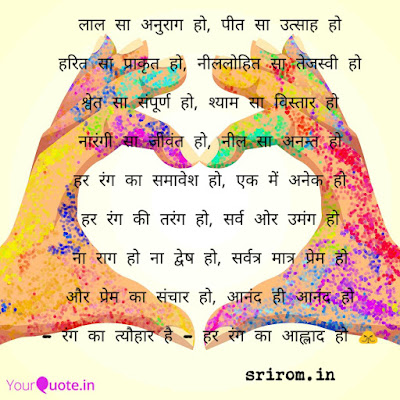

Since we are talking about nature &
colors, that too in March, it clearly states that we are all set in Holi mood.
The most jubilant festival around the world, Holi indicates the change in weather, the arrival of summers. The Spring Festival of India, Holi - triumph of good over evil, the universal theme of all Indian Pauranik legends. The festival is celebrated on the full-moon day of Phalgun. Since we expressed nature’s correlation with festivals in the beginning, let’s learn the Holi side: A day before Holi, people gather around, in the evening for a bonfire. People light up bonfires of dead leaves, twigs and sticks and dance and sing around it to welcome the Spring and commemorate the saving of Prahlad and burning of his wicked aunt Holika. People take embers from this holy fire to rekindle their own domestic fires. This fire also helps in killing the bacteria present in the air as well in the body; people also include camphor powder in the fire that cleans the air. The ashes of the Holi fire are believed to have some medicinal properties. The day after burning the Holika, people put the ashes from the fire as Vibhuti on their forehead, often mixed with Chandan paste (Sandalwood paste), which is known for calming body and mind.
Do You Know: In many parts of North India, the celebration of Holi is extended for 4-7 days and one such tradition is followed in Kanpur:
Back in the pre-independence era, when Kanpur was also known as the revolutionary capital; during ‘The Quit India Movement (1942)’, the freedom fighters hoisted the tricolour on the day of Holi, declaring India free. It infuriated the British administration and the freedom fighters were arrested with immediate effect.

But the British were unaware of the perseverance of Kanpurites, who stopped playing Holi and demanded the release of all the freedom fighters. The British submitted and released the captives. Coincidentally, the day of release fell on the auspicious occasion of Anuradha Nakshatra. Overjoyed people of Kanpur celebrated the festival the whole day and in the evening met on the banks of holy Ganges.
Holi is known as the last
festival of Hindu calendar; hence what follows is Hindu New year, i.e. the
Navratras, celebration of the divine feminine. Though people celebrate the nine
forms of Bhagwati Durga, the followers of Shakt-Sect also observe these days in
reverence of ‘Adi Shakti’, the source to all, in her “Das-Mahavidya” forms, the
ten aspects of Shakti.
Adi Shakti, is recognized as the
first deity by the Shakt-Sect people; she is also identified as ‘YogMaya’, the
source of Bhagwan Vishnu’s powers. When looked upon from the creation aspect,
she is said to have split herself in three forms: Satva, Rajas & Tamas. As MahaLakshmi,
she is Vishnu’s sattavik shakti; as MahaSaraswati, she is Brahmma’s rajsik
shakti; as MahaParvati, she is Shiv’s tamsik shakti.
Further, Adi Shakti is recognized
in her ten forms, Dus Mahavidya, the provider of great wisdoms and segregated
in two disciplines: Kaali-Kul & Shree-Kul.
The goddesses of Kaali-Kul are
believed to be of fierce form and frightening appearance, which includes: Maha
Kaali, Tara, Chinnamasta & Bhuvaneshvari.
While the goddesses of Shree-Kul
are believed to be benign and kindly, which includes: Maha Tripursundari,
Tripur Bhairavi, Dhumawati, Bagalamukhi, Matangi & Kamala. Except
Dhumawati, the other devis have eternal-youthful appearance.
In spite of the two disciplines and the variance in appearances, these goddesses are known to be benevolent to the devotees who have faith in their heart, while for the corrupts, they are fierce and punishers.
Do You Know: The Guhyatiguyha-tantra associates the Mahavidyas with the ten avatars of Bhagwan Vishnu, and states that the Mahavidyas are the source from which the avatars of Vishnu arose, for instance, Tara is known as Bhagwan Ram’s shakti.
This is the true depiction of Sanatan Dharm, where Gods & Goddesses are worshiped alike, in fact, goddesses described as power center of the Gods. And the festival of navratra defines the significance of feminine, without whom masculine has no existence. The reason behind the famous verse:
"यत्र नार्यस्तु पूज्यन्ते रमन्ते तत्र देवताः"
Gods reside only where women are respected. Such a glorious picture and indeed true if we read our legends, our history.
Before we get carried away, I would like to bring the following into your cognizance:
Before we get carried away, I would like to bring the following into your cognizance:
- Six year old kindergarten girl child raped.
- One and a half-year-old girl was allegedly raped by a 33-year-old man in the presence of his two children.
- A one-and-half-year-old girl was allegedly raped by her uncle.
- An eight-month-old baby girl has been raped, allegedly by her cousin.
- Man raped girl 250 times over 5 years.
- 11 Years Old, a Mom, and Pushed to Marry her Rapist.
- 14-year-old girl was raped in a “horrendous attack” in broad daylight in a ****** park
I know this comes as very disturbing, after the vivid "goddess" description, this could have been avoided to keep the colorful picture in all good sense. But that won't change the ugly sides, would it? The month of February shocked us with some of the above mentioned incidents. And before you try to flag certain region/country, let me make it clear that the above mentioned atrocities have been reported not from one country, but from all over the world and I have mentioned just a few.
What is wrong in the world, what is wrong with the world; why so much insensitivity that even a eight month girl-child isn't spared in order to satiate the lust of a grown up serene person who is very much part of this society and the family. How could mankind stoop so low that man forgot everything before committing such horrendous act.

It is now pretty common for such news, finding space in the front page, on a daily basis. Even people have gone 'used to' with these news, having following reactions:
- What! another rape?
- Oh, poor girl.
- What was she doing out at late night?
- What is the police/government doing?
- Rape only happens with characterless girls.
- She was roaming with her boyfriend, so what if some more men did it.
And then comes the classic:
- Look at her clothes, it was bound to happen.

People have reactions/opinions/comments for the victim that sums up in three words, it's her fault. But not much for the offender. The trauma that a woman goes through, how much does the rapist is effected, not even a minuscule.
And if we try to reason this heinous crime, it will make us question: must we exist? The sheer will to address the sexual desires/fantasies/ to prove the manliness/ to not let the other gender rise/ to keep them suppressed/ to teach them a lesson and the endless list of disgust that question the psyche of such people. Here to make one thing clearer, it does not have to do much with education as we have seen cases of sexual offences in corporate as well.
There's a famous saying, education starts from home and so does the teaching of right values. We have a rich cultural heritage, but how much we pass it to our next generations; forget passing, how much are WE aware of our real values, real history? And before someone asks 'what does history has to do with values and stuff', allow me to illustrate:
When Bharat returned from Kaikeya and found his father, deceased and elder brother in exile, this is what he questioned to Kaikeyi:
‘Tell me mother, what offence was committed by brother Ram that he was sentenced for exile. I can’t even dream of him doing anything wrong. Did he kill any innocent or had he his eye on a strange woman?’
{Valmiki Ramayan; Ayodhya Kaand}
Ramayan has always guided me in terms of LEARNING. This one dialogue clearly states the lifestyle, the psyche, the virtues followed in those times; times when Dharm was the guide to live an ideal life. Even the royalties were bound by the societal norms that believed in parity.
The next question that may come to the mind, questioning the historicity; if everything was so good, then what fractured the mindset, that a woman is burned, private parts mutilated, tongue's cut, body severely wounded: to keep her mouth shut, to crush her soul/her morale. So what really happened; we lost in transition. The medieval period when Bharat-bhoomi fell prey to foreign invasions: men killed with absolute inhumanity/ women raped & tortured with absolute cruelty/ kids slaughtered with brutality; our very foundations, our very beliefs were subdued by destruction of historical temples and ashrams along with burning of our knowledge base (Nalanda University for instance). Child marriage & Ghoonghat/Parda system and many malpractices originated here.
Then came the British era and we were completely ripped off, in order to introduce their colonial education system, our sanskrit and sanskriti were demeaned and paved way to today's times, where we are oblivion to our roots and whatever any intellectual 'enlightens' us in the name of history, we tend to believe it (take Aryan-theory for instance).
Then came the British era and we were completely ripped off, in order to introduce their colonial education system, our sanskrit and sanskriti were demeaned and paved way to today's times, where we are oblivion to our roots and whatever any intellectual 'enlightens' us in the name of history, we tend to believe it (take Aryan-theory for instance).
Dark times make us feel vulnerable, but its always up to us to rise and bring the change, to be the change. Till our mindset is eclipsed with bias or prejudice, such offences to women will continue to happen. this prejudice is ingrained deeply in our minds due to centuries of oppression and slavery that we have forgotten our actual values and gave in to the fabricated ones.
I always say, in order to rise to sentience, we must be proud of our roots, our immense heritage. And to be proud, we must
believe in our heritage; and to believe, we must be aware of our heritage; and then there won't be place for evil. And that would be the age of perfect regime, RamAeon, age of Ram-Rajya.
See you next month.
'सियाराम'
[Visit my website: www.srirom.in to access my social profiles]

Comments
Post a Comment